
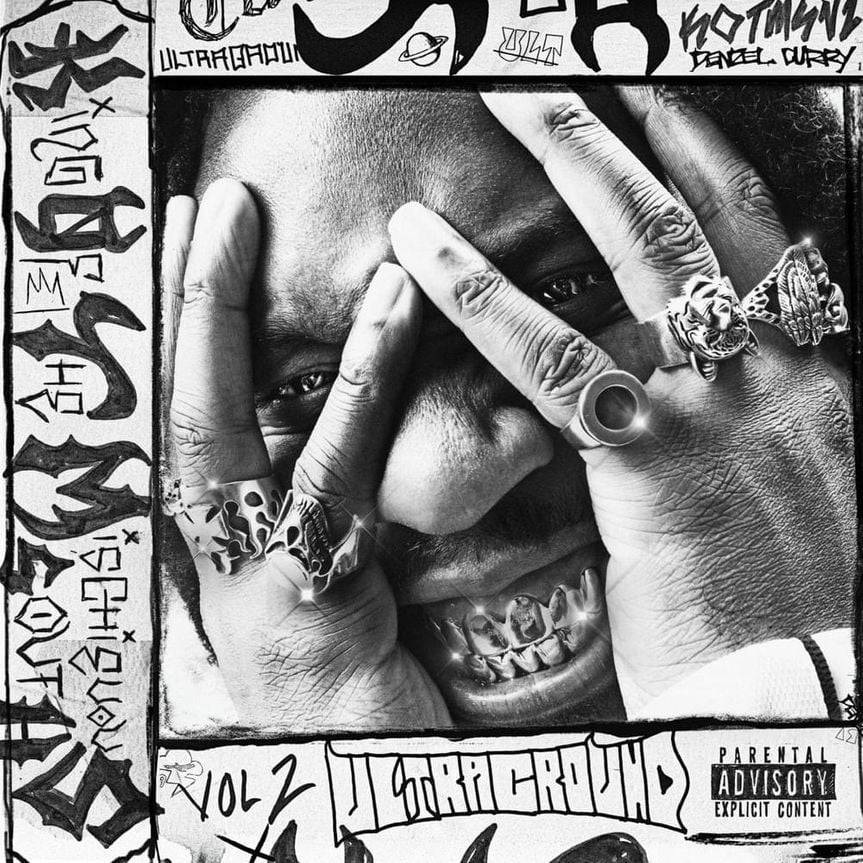
Denzel Curry – King Of The Mischievous South Vol. 2
Despite feeling like his least essential album yet, KOTMS v2 is a highlight reel of Southern hip-hop bangers.
Denzel Curry’s newest album comes at an interesting crossroads for his career. Almost 10 years on from breaking out with his viral single “Ultimate”, he’s managed to cover numerous bases in hip-hop before even reaching his thirties. From the three-part concept album TA13OO, to the Florida hip-hop love-letters on ZUU, and even his collaborative UNLOCKED EP with Kenny Beats, he’s managed to demonstrate both his consistency and versatility as a rapper.
Nowhere was this more clear than on 2022’s Melt My Eyez See Your Future – arguably Curry’s best work to date. Where TA13OO was personal in a dark, aggressive sense, Melt My Eyez saw Denzel in a calmer state of self-reflection, managing to blend his trademark Southern hard-hitters with jazz rap production and meditative deep cuts. It felt as though we were seeing the start of a new, more introspective phase of his career. Following such a departure from his usual sound with King Of The Mischievous South vol. 2 might feel like a bit of a swerve, but it’s not an unwelcome one.

The record is a sequel to one of his earliest mixtapes – only available now through unofficial SoundCloud reuploads by fans – and fully embraces the sounds and ethos that gave way to his career beginnings. KOTMS v2 is a “Who’s Who” of the Dirty South scene and crowns Curry as its modern flagbearer. While the music here sounds rough-and-ready by design, its presentation is very smartly calculated to complement it, with cassette sound effects, frequent interludes, and distorted mixes emulating the sound of an underground project that would be passed around with hushed tones by local tape traders.
Introduced by Tennessee legend Kingpin Skinny Pimp, and with later features from Juicy J and Project Pat, KOTMS v2 seems to be a passing of the torch to the South’s modern-day keystone artist. It hits its stride right off the bat, with an exhilarating opening leg of Memphis rap-inspired highlights. “ULTRA SHXT” is a unique intro featuring the cloudiest beat of the tracklist, showing how deep Curry’s appreciation for his influences runs, as much as his vocals struggle to cut through such a dense mix. “SET IT”, by comparison, features much more conventional hallmarks of the Memphis sound. With ominously violent lyrics, cold synths, an earworm hook, and a standout guest verse from Maxo Kream, it’s almost effortless in its imitation.
“[King Of The Mischievous South Vol. 2] fully embraces the sounds and ethos that gave way to his career beginnings.”
“HOT ONE” and “BLACK FLAG FREESTYLE” round out the first third of the album with a clean one-two punch of thumping singles, each with brilliant guest verses that show the variety of the feature list’s talent pool. That Mexican OT in particular shines on his appearance, with his tight flows pairing perfectly with Denzel’s measured, enunciated delivery. The line “Yeah, I used to smart-talk, but now I had to dumb it down” summarises Curry’s change in attitude between Melt My Eyez and KOTMS v2, but it unfortunately foreshadows an issue with the project.
While every Curry album up until this point has seen a few lyrical duds or lacking hooks, the level of commitment to a “vibe” rather than a particular message here has made them much more glaring when they do appear. None are quite as bad as TA13OO’s infamous Peter Griffin and Donald Duck bars, but some refrains are still below Curry’s typically high standard. “G’Z UP” and “HIT THE FLOOR” both serve their purpose as speaker-knocking Deep South bangers, with the latter evoking a SoundCloud era XXXTentacion cut, but their repetitive refrains distract from the better segments of each song. Meanwhile, some of the record’s best wordplay is immediately undermined by Denzel feeling the need to explain his own material. “Even Jesus called a n**** out on his last supper”, he spits on “SKED” – which is otherwise the most well-rounded track here, before shouting “Judas!” just in case it somehow went over your head.

There lies the main problem with KOTMS v2 – it struggles to find balance. It needs to accommodate Denzel’s smart lyrics without being too heady to turn off casual listeners. It opens with such impact that certain later cuts struggle to keep up as the tracklist fills with intermissions. The result is a project that’s very effective at encapsulating a specific sound, but which doesn’t hold up to scrutiny once you look past the surface. It also doesn’t help that, as much as his scope has widened, this is the first major record of Curry’s that tends to cover ground he’s already explored. 2019’s ZUU, although focusing on Miami rather than Memphis, was a similarly trim tribute to the South, and one that managed this balance more effectively. After keeping such a positive trajectory for so many years, it’s a slight disappointment to see Denzel double back to familiar concepts.
“…this is the first major Curry record that tends to cover ground he’s already explored.”
Despite that, KOTMS v2 still sees many improvements on a technical and fundamental level, and its aesthetic is easily one of the most recognisable of Denzel’s career. His flows are the steadiest they’ve ever been, and his vocal chemistry with features is consistent across the board. While a more distinct ending would have been preferable, the final pairing of “HIT THE FLOOR” and “HOODLUMZ” crank up the distortion and provide some of the most intense deliveries on an album that’s already in-your-face at the best of times.
Although King Of The Mischievous South Vol. 2 has many elements working against it, it still provides some of the heaviest, catchiest, and most fun work in the Denzel Curry discography. It sees him returning to his roots with a new set of skills, re-packaging his earliest successes and presenting them to a new audience. It may not appear as high-concept or ambitious as other more notable landmarks of his catalogue, but it’s still a very impressive feat to have pulled off, and proves that Southern hip hop’s legacy is in safe hands.
GRADE: B
Review by Max B
 Record Scratch